I. INTRODUCTION
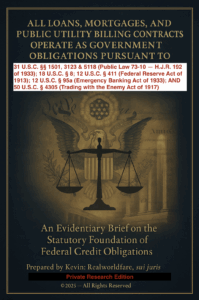
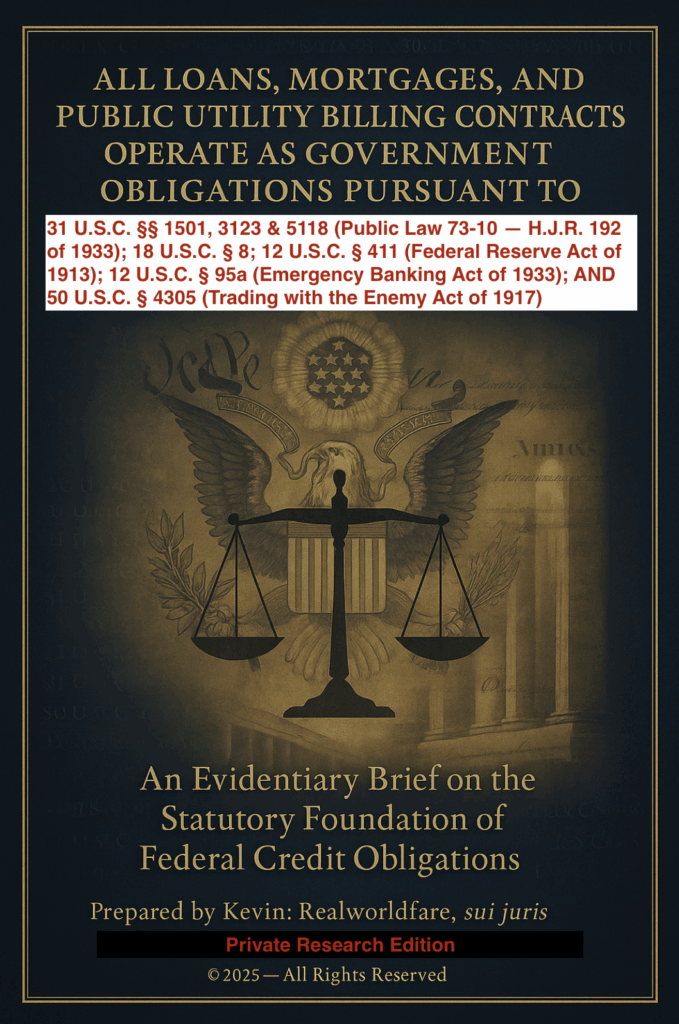
In modern commerce, few people realize that what they call a “loan,” a “mortgage,” or a “utility bill” is not a private contract between equals — but rather, a federally recognized government obligation. Through a closed-loop credit system created by Congress, every transaction involving debt or service billing is executed, recorded, and discharged as an extension of the public credit of the United States. This article exposes the legal scaffolding that transforms common financial instruments into enforceable government obligations.
II. STATUTORY FOUNDATIONS: FEDERAL CREDIT INFRASTRUCTURE
- 18 U.S.C. § 8 — Defines “obligation or other security of the United States” to include checks, bills, drafts, and other representatives of value issued under Congressional authority. This includes mortgages, loans, and utility bills once issued through banks or utilities operating under federal franchise.
- 31 U.S.C. § 1501 — Government obligations must be supported by written documentation: loan agreements, service contracts, and public utility billing. Subsections (a)(1), (a)(2), and (a)(8) specifically include these instruments.
- 12 U.S.C. § 411 — Declares Federal Reserve Notes as obligations of the United States, backing all instruments denominated in dollars. Every commercial transaction processed through a bank is an extension of this obligation.
- 12 U.S.C. § 83 — National banks may not lend their own capital or assets. Instead, the borrower’s promissory note is monetized into credit under federal authority, making the instrument a government obligation.
- 31 U.S.C. § 5118 & 3123 — Legal tender discharge of all obligations is guaranteed through credit, not specie. HJR-192 abolished gold payment and made every debt payable in U.S. credit. Treasury guarantees the payment of all such obligations.
- 50 U.S.C. § 4305 — Trading with the Enemy Act grants plenary authority to regulate monetary instruments during national emergencies, a power still in effect since 1933.
III. FUNCTIONAL REALITY: LOANS, MORTGAGES, AND UTILITY BILLS AS PUBLIC CREDIT
- When you sign a mortgage, you’re not receiving private bank capital — you’re generating a credit instrument backed by the United States.
- When you pay a utility bill, you’re discharging a recordable government obligation under statutory accounting rules.
- Banks serve as credit intermediaries; utilities serve as fiscal agents. Neither party lends value — they administer obligations.
IV. LEGAL CONSEQUENCE: THE UNITED STATES IS THE ULTIMATE DEBTOR
- Your signature creates the value.
- The bank deposits your promissory note and books it as an asset.
- The loan proceeds are recorded as a liability, and all movement occurs within the Federal Reserve System.
- Under Public Law 73-10 (HJR-192), this process is lawful discharge through credit.
V. CONCLUSION
The monetary and commercial infrastructure of the United States is a codified system of debt obligations rooted in Congressional authority, federal credit, and trust in public ledger systems. Every mortgage, loan, or billing account you enter into is not simply a private contract — it is a public debt, a securitized record, and a transaction carried out under the aegis of federal law. The borrower is the creditor. The instrument is the obligation. The bank is merely the processor. And the United States — through its statutes — is the party obligated to honor the credit you’ve created.
The truth is not hidden. It’s codified.